Showing posts with label watercolor paintings. Show all posts

Tuesday, September 10, 2019

CQJP 2019 - May Block, 1950s

Here she is, the all-American girl!  Women of the 50s became consumers.  They left the workplace after the men returned from war and went back to work.  There was a move to fashion and away from the practical.  No more rationing!  They were elegant, polished and charming.  It seemed the height of chivalry when men held the door for them, lit their cigarettes, helped them with their coats, carried their packages for them and treated their women quite royally.  The 50s was also the beginning of differences between more mature women and the young teens.  Neither imitated the other for the most part.  It was fun to be young yet also ideal to be the grownup.  My lady is the more mature woman who wore elegant clothing when they went out, cocktail dresses for the evening out and classic fashions during the day.  Mink coats and stoles, pearls, rhinestones, chiffon, silks, crinoline and other frivolous items were part of the wardrobes during the 1950s.


The ideal figure was tall with small bones, sloping shoulders, a tiny waist and a graceful neckline.  Hats and gloves were still very common.  Also common were hairstyles such as the French roll and Beehive, otherwise hair was shorter.  Emphasis was on the bust and hips and shoulder pads were removed.  Two types of skirt silhouettes were common, full skirts known as bouffant skirts emphasized a tiny waistline and straight skirts referred to as pencil skirts defined the curves and elongated the legs.   Sweater sets also flattered and emphasized a woman's figure. 

Lots of stripes, polka dots and checks/gingham were evident during this decade and styles were influenced by French and Italian fashion.  I chose yellow, black and white to reflect the elegance and European influence.  Of course every lady wore a girdle/garter belt and nylons (before pantyhose were invented).  Another indicator of the 50s were those flattering yet uncomfortable and "dangerous" stiletto heels.  


Although I painted a white skirt I decided to do a black netting over that area so it would show up better.  

Just a few of the influential people of the time included Elvis, Frank Sinatra, Annette Funicello, Doris Day, Audrey Hepburn, Grace Kelly, Sophia Loren, Marilyn Monroe, Elizabeth Taylor.  Lawrence Welk and American Bandstand were popular on TV.  Three Coins in the Fountain film, TV, drive-in movies, malt shops, and Vogue, Glamour, Mademoiselle Magazines all influenced the 50s.  Popular dances of the time included Rock 'n Roll, the Stroll, Twist, Rock, Jive, Samba, Rumba, Mambo and Cha Cha Cha.

During the 1950s the USA was a dominant country with a stable economy with American made products.  Eisenhower was President during this time.  Alaska and Hawaii joined the union.  Inventions included TV, vacuums, freezers and of course the Barbie doll.  On the downside this decade is also affected by polio and the iron lung.

How many of you remember the 1950s decade?  Would love if you shared your experiences and memories!


Tuesday, March 26, 2019

CQJP 2019 - March Block and Watercolor Painting

March is finished.  There was a definite contrast between the 20s and 30s.  While the 1920s was frivolous and almost rebellious the 1930s brought with it economic, political and social turmoil.  Leading this was the 1929 Wall Street crash which resulted in what is referred to as the 'Great Depression'.  It was also the decade Hitler took over Germany.  This was the period in our history of the infamous couple Bonnie and Clyde.  Most lived practical lives with some women going to work to help support the family during the hard times.  The ideal woman was mature, efficient and reliable but there was also the spunky working girl.  Think of Greta Garbo and the chain-smoking Bette Davis.  There was a mood upswing later in the 30s decade which brought on gathered and shirred dresses, amusing jewelry and hats.

The 1930s was also a very innovative time.  Inventions during this decade included frozen food, all-color movies at the cinema, jet engine, FM radio, photocopier, ballpoint pen.

Popular dances such as the Rumba, Jazz, Jitterbug, Breakaway, Air Steps, Conga, Lambeth Walk, Chestnut Tree, Hokey Cokey and Samba were performed to the beat of what was referred to as Big Band music.  Entertainment besides dancing included the Cinema, horse races and the still popular today Wizard of Oz.

Influential people during the 1930s (and some beyond the 1930s) included Bette Davis, Greta Garbo, Jean Arthur, Rosalind Russel, Barbara Stanwyck, Marlene Dietrich, Joan Crawford, Jean Harlow, Shirley Temple, Katharine Hepburn, Scarlotte O'Hara, Ann Rutherford, Fred Astair and Ginger Rogers.  Several of them were stars of the Cinema and had a huge influence on fashions of the day.

2019 CQJP - March - 1930s

Speaking of fashion, the 1930's took a turn from the razzle-dazzle of the roaring twenties to a more glamorous, unfussy and ultra feminine mature style.  Even young college-age women looked more mature with their long skirts and practical working shoes.  Hems went longer, about 10" from the floor or some even to the ankles.  

Hair was styled into long soft 'finger waves', plucked arched eyebrows and rococo curved lips were also on trend. 

The silhouette was more natural, slinky and sculptural, showing off their feminine curves and natural waistline.  Waists were often belted.  The look was glamorous, elegant and refined yet casual.  

Everyday styles were created with fabrics such as rayon, linen, crepe du chine, chiffon and cotton cleverly cut on the bias.  Floral prints and solids were common.  Printed flour sack fabrics were still commonly used.  Removable collars and cuffs, veiled hats, gloves, costume jewelry and other accessories were often used to change the look of an outfit.  

Silks and satins and laces were reserved for intimates and evening wear, some with a train on the skirt.  Backless dresses were common in evening wear.  Tank vests were often worn instead of brassieres.  Luxury fabrics and expensive beading was not readily available so designers had to be creative.  Styles emphasized the waist through use of color, necklines and pleating.   Shimmering fabrics, ethnic embroideries and amusing jewelry finally emerged in the late 30s.

Common trends included furs, monograms, Jabots, Dirndls (late 30s), gored dresses, penney loafers, Oxford shoes, T-strap heals, baroque shoes, slip on pumps, bandeaux hats and trumpet skirts.  All shoes had a heel.  Many shoes from this decade had perforations (tiny holes).  Bracelets and a watch was often worn over top of gloves.  Hats might cover one eye or large picture hats were worn.  The ideal figure was tall with a small bust and narrow hips.

Pants and blazers, shirt dresses for daytime, and Peter Pan collars inspired by menswear were worn for the first time.


1930s Decade Lady - Copyright Connie R Eyberg

Popular art of the 30s was abstract, expressionism, Bauhaus school of Art, and by artists such as Kooning, Jackson Pollock and Wassily Kandinsky.

In my crazy quilt block I included collars which might be added to a dress or blouse, simple cotton lace, vintage buttons and some pearl beads.  The fabrics are all reproduction 1930s.  I tried to keep it fairly simple for this period of practicality.  Hope you enjoyed learning a bit about this decade!


Thursday, February 7, 2019

1920s Decade - Century Ladies


My 1920s painting is completed and fabrics have been chosen for my next crazy quilt block.  This was a somewhat frivolous decade and I will be adding lots of glitz and glamour to my block, a huge contrast to my 1910s crazy quilt block.  It should be lots of fun but more time consuming with lots of added embellishments such as beads and sequins added to already shimmery fabrics.

1920s Decade Lady - Copyright Connie R Eyberg

The 1920s, often referred to as the Jazz Age or Roaring Twenties, was the era of Flappers, gangsters and bootleggers.  The war was over, women had new strength and confidence as many went to work.  Besides the end of WWI, the 19th Amendment was ratified giving Women full voting rights thanks to the Womens' Suffrage Movement.  Women gained a new independence and were now free to vote and to drive, and many even took up smoking.  Other influences during this decade included prohibition, development of auto assembly lines making autos more affordable to everyone, discovery of Penicillin and the height of the  Industrial age.  The discovery of King Tut's Tomb brought about an Egyptian influence seen in the fashion industry as well as other applications.  The style during this period is referred to as Art Deco and can be found in the visual arts, architecture and fashions of the day. 

Among the influential people were pioneer aviator Amelia Earhart; racing pilot Jacqueline Cochran; actress, model and dancer Louise/Leslie Brooks; and actresses Greta Garbo, Lillian Gish, Pola Negri, Gloria Swanson and Clara Bow.  Popular music and dances of the time included Charlseston, Tango, Two-Step, One-Step Quick-Step, Turkey Trot, Fox Trot, The Black Bottom, Varsity Drag, The Shimmy and French Tango.  Besides Art Deco, Bauhaus Constructivism, Cubism, Futurism and Dali Surrealism could be seen in the art world.

Previous to the 1920s the ideal was a more mature and sophisticated woman.  Now for the first time women desired a more youthful fun look.  Hemlines went up to the knees and waistlines dropped to the hips during much of this decade.  A flat-chested boyish silhouette with long slender neckline, broad shoulders and long legs with rolled down stockings was in vogue as dresses hung loosely, with little form.  The long straight flat dress was easy to sew.  Among fabrics used were metallics, delicate, thin and airy, rayon, silk, crepe chiffon, mostly in  bright solids or muted pastels along with knits for sportswear.  Egyptian motifs, beads, embroidery, ribbon, stripes, polka dots, large plaids and simple florals were popular.  Hairstyles became short, shingled styles with bangs.  The "bobbed" hairstyle was often topped with a popular Cloche or flapper hat framing the face.  Accessories included long strands of beads, bracelets and/or watches worn over gloves, small, often beaded, handbags, large plume fans, boas or fur wraps, bow pumps, and boxy jackets.  Styles included the flapper/garconne dresses, bare backs, handkerchief hems and everyone owned a plaid overcoat.  Makeup emphasized large eyes and small red bee-stung-look lips.

Tuesday, January 1, 2019

CQJP 2019 - 20th Century Ladies

2019 is here and I'm ready and excited to begin my Crazy Quilt Journal Project for this year.

As you may know I am a watercolor artist and crazy quilter, so it seemed natural to incorporate some of my paintings into my quilts.  My latest endeavor is painting fashion ladies from each decade of the 20th Century trying to incorporate the character, fashion and mood of each decade.  I thought it would be interesting to create CQ blocks for each using fashion colors and some of the fabrics from each individual decade.  It has been absolutely intriguing studying the fashions and learning what worldly influences and public figures affect the styles and attitudes in women's fashions.  Since there are obviously only 10 decades in a century and I have already created my 1900s painting and block it will not work for a full year so I have pre-planned how I will finish out the final three blocks.  You will have to stay tuned for those.

1900s:  My first painting and CQ block was done previously.  It was a lady for the 1900s.  Fashion at that time was pretty uncomfortable and unnatural for women.  It was referred to as Edwardian and included the infamous 'Gibson Girls'.  1900s ladies wore very restricting undergarments that cinched the waist tightly and forced the figure into what is referred to as a 'S' shape where the bust is forced forward, the waist tiny, and the behind extended.  The fainting couch was popular at this time because their corset was cinched so tightly causing the lady to faint.  Can you imagine!  Stiff high collars kept their noses in the air.  Other indicators of this decade in fashion included large, large brimmed hats, gloves, fans, umbrellas, heavy embroidered gowns, large single bustline (uni-bust) with a large flower in the center.  Colors were soft pastels and whites but could also include royal purple, blue, deep red and emerald green.  Fashions often included ruffles and embellishments such as rhinestones, lace and ribbons.  In other words, very feminine, delicate looking but constraining.  The 1900s and in previous decades Victorian etiquette and customs were very formal and included such topics as calling cards and visiting cardstea etiquette, and it is fun and interesting to read about the language of fans and language of flowers.   I provided links to some of these but it is easy to find an abundance of information on all topics relating to the Victorian period on the Internet and in books.

Influential people included Sarah Bernhardt, Lily Langtry and of course the Queen.  Auto Chrome photography was invented in 1907.  The Theatre was popular entertainment.  Dances included "Boston" Waltz, Two Step and the Chasse'.

Following is my first painting and CQ Block.

1900s Lady - original painting copyright Connie R Eyberg Fine Art

1900s Lady Crazy Quilt Block

1910s:  My next block and the first for my CQJP 2019 is the 1910s lady.  This period also is referred to as Edwardian.  Fashion was influenced by Japanese and during much of this decade and normally included a blouse, skirt, dress and coat.  The heavy corset was abandoned for a less restrictive style, replaced with a straight, more natural figure without the frills and flounces.  The early 1910s was defined mainly by the popular "Hobble" skirt.  I suppose this is where the term 'hobble along' came from.  The length was around the ankles and early on they were so tight around the ankles it was extremely difficult to walk.  This was remedied by adding a bit of fullness, pleats and slits.  The tops were loosely cinched just above the waistline, necklines were V-shaped but with a blouse underneath and sleeves were long and looser.  Colors were brighter and included colors such as purple, pink and peach.  Large often over-sized hats were popular yet, but the brims became narrower and feathers were quite commonly used as adornment on the hats.  I did a painting of a lady in this style but didn't include her in the block. 

Early 1910 Lady watercolor painting - Copyright Connie R Eyberg Fine Art

About mid 1910 WWI had begun but the USA wasn't fully involved until around 1917.  Styles became more practical with fuller skirts (called Crinolines and considered more patriotic and practical) and shorter hemlines above the ankles.  The Armistice blouse came into being around 1918 at the end of the war.  Hats were still almost mandatory.  The tea gown vanished from the fashion scene.  Fashion colors became darker going into the copper, grey, browns, black, still some whites, burgundy, deep blues/navy and gold tones.

Influential people included Mary Pickford, Helen Gardner, Theda Bara, Pola Negri, Isadore Duncan, Lole Fuller, Gloria Vanderbilt, Tina Chow, and Gretta Garbo.  Fashion designer Paul Poiret and his wife Denise who modeled his Empire line dresses (Lecallier) greatly influenced the new fashion.  Fashion, hair and make-up was also influenced by the Silent Screen, Nickelodeon and Movie Stills.  This is also a time of the famous Titanic.  When war started women became involved by filling in vacancies left by men who had gone to war.  You have probably also heard of Rosie the Riveter who led the way to women contributing to the war efforts and resulting in a new confidence by women.  Interestingly also, although men's fashion, a designer named Burberry was commissioned to adapt an army officer's coat for the trenches and the Trench Coat was born.  Popular dances included Castlemaxixe, Ragtime, Tango, Fox Trot and Turkey Trot, Bunny Hug, Duck Waddle and Grizzly Bear.  It is fun to look some of these up on YouTube.  I would say the biggest influence of this decade was WWI making clothes darker and less frilly and more practical and also leaving women with a new confidence and awareness of their own strength.  The Women's Suffrage parade was held in New York City and NAOWS (National Association Opposed to Women's Suffering) was organized.  The actual timeline of the women's suffrage movement is here.

Lots of changes during this decade for certain!  Below is my second painting showing the general style by around 1915. 

Late 1910 Lady - watercolor painting copyright Connie R Eyberg Fine Art
Here is the naked block ready for stitching.  It isn't a very clear image but as you can see it is a stark change from the 1900 block.  There was still some lace and trims used in 1910 but not near as heavily used as in the 1900s.

1910s Lady Naked Crazy Quilt Block
This month I hope to finish up the stitching on this block and get my lady painted for the 1920s block.

Happy 2019 to you all!


Monday, December 31, 2018

Commissioned Watercolor Painting and Drawing

Now that the holidays are over I can post two commissioned pieces I created for clients.  Both were Christmas gifts so I couldn't post them until I was sure I wouldn't spoil the surprise.

The first one is titled "Friends in High Places".  The client's husband is a lineman for the power company and she wanted a personal painting with him on a power pole, vertical format, the look of a storm having just passed and homes/landscape showing in the background.


The second one was of a former family home.  It is a drawing and she ordered prints for each of her kids to enjoy.  She said they always had cats and kittens so she wanted a couple incorporated into the landscape somehow.


Tuesday, November 20, 2018

I'm Back!

My goodness I have been neglecting my blog!  Thank you to those of you who have stayed with me.

I haven't been stitching a lot or doing much of anything with fibers as I have turned my attentions to my love of watercolor painting.  Although I have been doing little projects here and there I haven't shared them here.  The "itch to stitch" is back.  I will be stitching and checking in more this coming year as I have signed up for CQJP 2019.


Watercolor Painting by Connie Eyberg
CQ Block incorporating painting printed onto fabric
    

My 12 blocks will be entitled "Century Ladies".  Above is a 1900s lady I painted and then printed onto fabric and made part of a cq block using period fabrics and colors.  My intention was to do this for the 1910s through the 2000s.  I painted a 1910 lady but wasn't entirely happy with her and got "distracted".  I decided to make this my challenge for 2019 in the hopes it would pressure me into completing the series.  I hope to keep up as it will involve painting a new lady for each month in addition to creating my blocks.  I have already gathered some period fabrics so I should be pretty well set there.

Stay tuned and wish me luck!


Thursday, October 20, 2016

Wenasaga Sunrise Watercolor Painting and New FB Page

I have been neglecting my blog again!  I have been emerging myself in painting and a bit of crochet lately. 


This is my most recent painting.  It is called "Wenasaga Sunrise".  I have been doing a lot of experimenting with various sky effects and light.  I really enjoyed creating this painting.

I have also been working on a crocheted infinity scarf.  The crochet part is completed.  I now have to block it and then add beads.  When I figure out how I am going to block it, adding beads will be easy.  I am open for suggestions on how to block an infinity scarf with lots of picots!  Can you just use some sort of fabric stiffener or spray starch and iron it?
  
If you are on Facebook I invite you to visit and Like/Follow my page.  The Link is https://www.facebook.com/conniereybergfineart/ or click HERE.


Friday, July 15, 2016

I have been neglectful of my blog.  Lots going on.  My family just returned from a trip to Breckenridge, CO.  We try to go there every year and have been taking our granddaughters with us the last few years.  They love it as much as we do.

I have been making a concerted effort to get more serious with my watercolor painting.  I have been doing some paintings from vacation photos and just recently started a series of paintings of local landmarks, buildings and statues.  I joined the Iowa Watercolor Society and have had one of my paintings accepted into their upcoming show.  Winners won't be announced until later in August.  A friend and I went to Perry to see all of the other accepted entries.  There is so much talent in Iowa.  I am just thrilled to have my work among them, especially after seeing the exhibit.  My friend took this photo of me with my painting "The Visitor".  It is from a photo I took while in Venice last year.


I have also been doing some stitching.  Pamela at Kitty and Me Designs had a contest for the 2017 crazy quilt calendar which she publishes along with her quarterly crazy quilt magazine.  Her theme was a secret garden.  I love 'glampers' and the idea came to me instantly.  I was late getting started so I stitched for hours everyday for about three weeks to get my idea made into a finished block.  It was time well spent because I ended up winning the cover spot!  I am familiar with several of the fabric artists that will be included in the calendar so I am really looking forward to seeing their creations!  The calendars should be available to order soon.  Check out Pam's blog to find out how to order one and how to get her magazines as well.  Her site is http://kittyandmedesigns.blogspot.com.  While there you can also be inspired by her beautiful work and find information for the next contest for the 2018 calendar.


Another project I have taken on this year is learning Traditional Quilting by doing a series of blocks through a class by Kathy Shaw.  Her classes which also include crazy quilting are wonderful and very clear and precise...and free!  New to quilting or experienced I am sure you will learn from her.

These are three of my blocks.  Each gets more difficult.
This is the last one I completed.  I have two more to go.


We are still working at growing our organic Aronia Berries.  We met with the organic inspector this morning as part of the process to get certified organic.  We should have had berries two years ago but a tornado and heavy hail at the farm left our bushes as mere stems.  They have come back but it set us back a couple of years.  We should have some berries this year finally, after five years growth.  It has really been a struggle.  We now have Japanese Beetles that quickly devour the leaves.  There are products that will get rid of them, but the organic spray we have to use takes continuous applications and is pretty costly.  Our eyes have been opened as to why "organic" is expensive.

This shows some of the damage from the beetles

Damaged leaves but they seem to leave the berries alone

Here is one of the pests.  They are usually in large clusters and work quickly.

Many of the berries are already turning.

I parked the truck in the shade, looked up and found a mulberry tree!  Yay!

Ragbrai, a bicycle ride across Iowa, begins July 24.  We will have bicyclists from Chicago and Wisconsin staying with us the night before the ride begins.  It starts in Glenwood, just a few miles south of us, this year.  We will meet our friends down there.  My husband and his friend will ride the entire week.  I have decided not to ride this year as I have not been training and since it will be a really hilly ride I would be struggling.  I may take my bicycle along an maybe ride a day or a couple half days.  I'm just wavering on this.  We will be spending two nights with my old college roommate and I am excited to get to see her and visit since it has been quite some time, several years in fact, since the last time we were together.

I have been rambling on!  First there is no word from me and now I can't seem to shut up.  Lol.  Hope you are all enjoying your summer!

Monday, December 21, 2015

Another Watercolor Painting - Portland Head Light Lighthouse in Cape Elizabeth, Maine

I decided to paint a scene from a photo I took during our trip to the Portland, Maine area where we went for a family reunion and to visit friends a few years ago.  I'm sure many of you are familiar with this lighthouse which was commissioned by George Washington around 1787.  It is called Portland Headlight and is the oldest lighthouse in Maine.  I thought it wouldn't be as detailed as the paintings of Italy I did recently with all the structures, tiny windows etc.  However, as I began to sketch this out it dawned on me the rock formations are almost as descriptive as the building.  They were actually formed by volcanic activity millions of years before.  Just any rock formation and color wouldn't do so I found myself getting into a lot of detail again.  There is a lot of history that is interesting.  I am always at kind of a loss when I finish one painting and before I start my next.  I do have two more paintings in mind from photos I took while in Maine and I'm looking forward to getting started on them.


I have been also doing some crazy quilt stitching but haven't had a chance to photograph that yet.  Hopefully I will be posting that soon - maybe after I finish the project.


Thursday, November 19, 2015

Watercolor Paintings of Italy

I have been pulled away from crazy quilting and all other things with fibers/fabrics as my watercolor paints and blank papers were calling my name.  I guess I was inspired by our recent trip to Italy.  Thought I would share.  My fabrics are calling me again and so have my beads but I am in the middle of another painting.  I want to finish it so I can clean up before my Thanksgiving company comes for dinner.


Thursday, September 3, 2015

Watercolor Painting and Macrame - check!

Stepped away from crazy quilt blocks this past week to fill a couple orders.

The first is a watercolor painting that was commissioned.  I had never personally seen the home until I delivered the painting and really worried I had missed some detail in the photo that was provided.  The client seemed very pleased.  I love painting!  

I do tend to worry and fret when I am working on a painting for a client.  One false move or spill can ruin the painting and make it necessary to redo it all.  There are some tricks to fix minor problems that I've discovered.  I have essential tremors (shaky hands) and have to be especially careful with details such as the scrolls in this painting.  It is always a relief when I finish.  I hadn't painted for quite awhile so now I have the urge to do more and I'm already mulling over ideas for my next painting.


The following little guy is from my last post.  There was a request for one from a friend.  Done and on its way to Canada!  


Now to figure out my next block for CQJP 2015.  I will be falling behind the next couple of months as I have a week I will be spending with my granddaughters while their mother takes a class out of town and then spending two weeks in Italy.  So excited about the upcoming trip!  If any of you have advice, please share as I have never been there before.  Anxious and excited at the same time!

Wednesday, April 15, 2015

Watercolor painting - Yellow roses

This is so pretty.  I think maybe I need more contrast and color variation in my roses.


Friday, November 16, 2012

November CQJP - Introducing My Kids

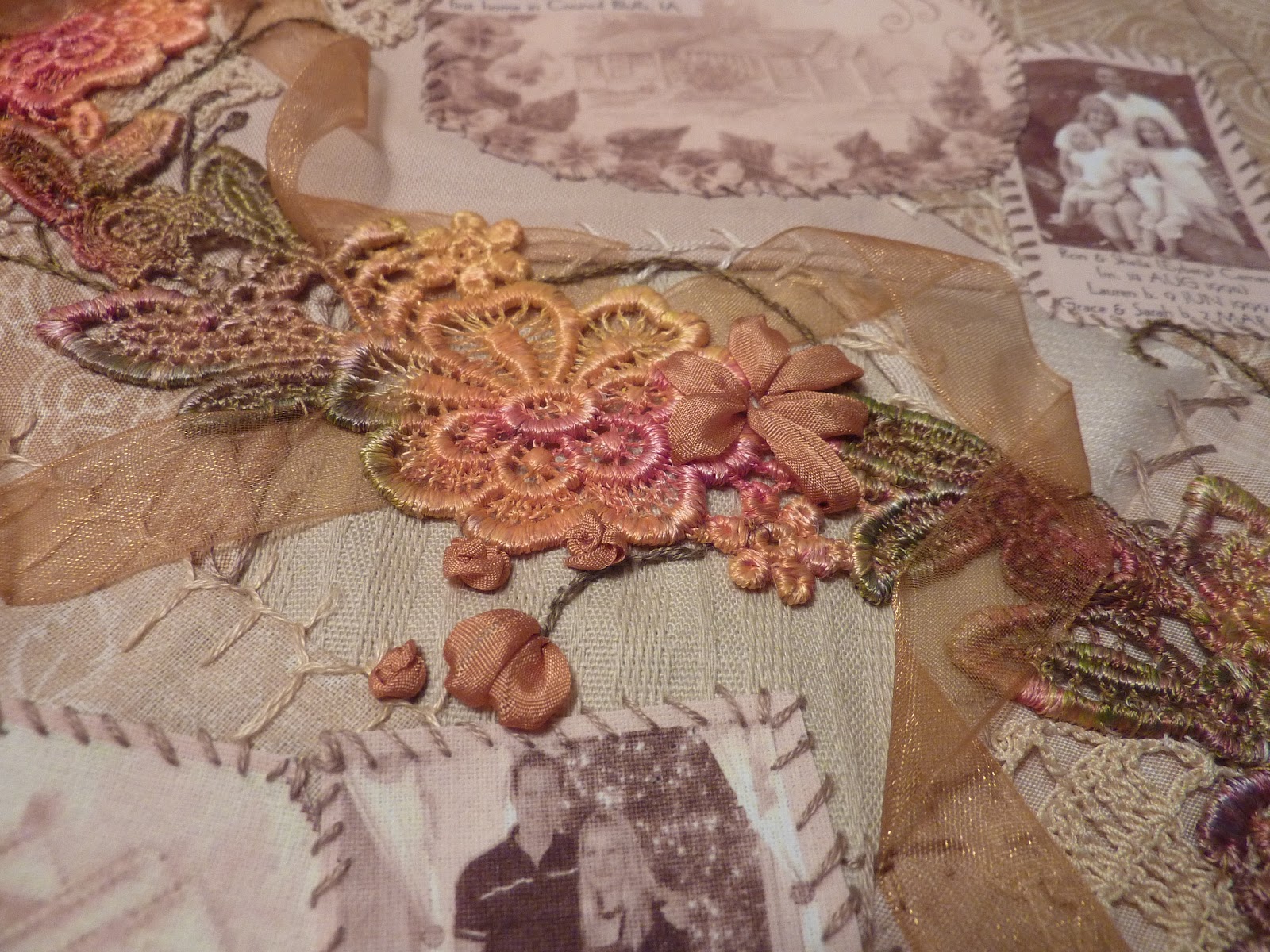
My November block is finished.  I have featured my children and grandchildren.  The birthstone for November is Topaz.  I'm sure you spotted the skeleton key representing my "keys to the past" series of blocks.


I began by printing off and laying out the images with some lace to separate them.


I dyed the lace to go with the month's colors.


The photos below just show some of the steps and close up details.


Again, I used images of the homes I painted in watercolor.  Both paintings were done for my senior thesis in 2002. 

The first is my daughter's first home.  This is a little pink cottage home that is surprisingly large on the inside even though it looks tiny from the street.  The multi-window room (behind the bush) is a sunroom with french doors off the dining room.  The woodwork and detail inside the home was all original to the house.  She has moved twice since, but this is where she was living when she was a college student, graduated college, and later married.  She and my SIL lived here for a brief time after they were married.


This is my son's first home.  He and his wife still live here.  My son is a woodworker and they have remodelled the inside.  It is spectacular and the kitchen is unbelievably beautiful.  Maybe I'll share photos one day.


Below is the closeup changed to sepia tones.

Thursday, October 18, 2012

WC Painting and CQJP 2012 - August (Peridot) Block submitted in October

This month's block includes one of my oil paintings from a few years back along with the watercolor.  This is a painting of two of our horses, Taffy and Star.


This watercolor painting is of the house I grew up in.  We had peony bushes and tiger lilies and a huge lilac bush that were planted by my grandmother.

Friday, September 7, 2012

Completed WC Painting

I finished my watercolor painting.  It had been so long since I last painted and must admit I enjoyed getting back to it.  It is a bit overcast here today, so I wasn't able to get as good an image as I would have liked.  This is painted from a photograph taken in Nassau, Bahamas.  My son and daughter-in-law were married on this very site.  That was over ten years ago and it still seems like yesterday.  I couldn't imagine a more beautiful location!  It hasn't been matted or framed yet.  My son has made the frame for it.


You may have seen my previous post in which I showed you the problems I was having with the liquid mask.  Thanks to help from many sources I decided I had not let the liquid mask dry enough before trying to remove it.  Lesson learned!

Sunday, August 26, 2012

Watercolor Painting - problems with Masking Fluid - Call for Help!

My son and d-i-l were married in the Bahamas with a beautiful and serene setting.  They wanted me to do a painting of the setting for them which I was excited to do.  However, I ran into problems.  Does anything ever go smoothly?  I used masking fluid to protect the white areas and when I attempted to remove it by gently rubbing, it tore my 300 lb. wc paper.  There is a close-up of the damage below.


I have used masking fluid in the past but in small areas, with much success.  This is the first I have tried it in a larger area.  Any artists out there with suggestions?  I have the drawing all done on a fresh sheet of wc paper but I'm afraid to apply the fluid, but I don't know of an alternative other than being very careful and painting each area separately. 


Anybody...help?

Sunday, August 19, 2012

CQJP 2012 - August Submission

Here is the block which was completed in June for my CQJP 2012 (see link on my sidebar).  This block represents the month of June which makes many people think of weddings.  In the upper right hand corner you will see a bit of bridal lace.  The birthstone is pearl which is reflected throughout the block in the buttons and beading.  I reconfigured a section of lace in the lower right corner to represent a church.  I also have a photo of the church in Treynor, Iowa which was such a huge part of my life.  My great grandfather who lived with his family in the home to the left was a charter member of this church, so it has been important for generations of my entire family in both happy and sad occasions...baptisms, confirmations, weddings, anniversaries, and funerals. 


The rose is made of ivory ribbon which I dyed the colors of the Peace Rose.  It reminds me of the roses I used to find tucked between pages in old books that had belonged to my parents and grandparents.  Have you ever found any of those flowers hidden between the covers of books?  I always think about what memories the flower held, so special that the person wanted to preserve them forever.


Below is the painting I did of my great grandparents home.  Hopefully you can click on it to see a larger version.