Showing posts with label fabric. Show all posts

Friday, September 6, 2019

1950s Decade Ladies Work in Progress

I am almost finished with my 1950s block so I thought I would give you a sneak peak.

1950s Decade Lady Watercolor - copyright CREyberg
Above is my painting for the next crazy quilt block.  She is a feminine and confident 1950s lady.  Pencil skirts and Bouffant skirts were very popular during the 50s so to show this I painted a full sheer "Bouffant" over skirt with a straight "Pencil" skirt visible underneath.


When I pieced my CQ Block I was thinking I wanted some yellow, black and white for kind of a French feel.  Gingham, stripes and polka-dots were popular during the 50s so I proceeded to collect fabrics in the colors and patterns I had decided on.  My first attempt at a 1950s block (shown above) was done using the yellows, black, white and red in the ginghams, stripes and polka-dots but I wasn't very happy with the results and had difficulty as I tried to determine stitches and embellishments that would work.   Below is the revamped block with several of the patches replaced them with  black or black and white, still using primarily checks/gingham, stripes and polka-dots.  I will incorporate color, mostly yellow, with my stitching.  I'm much happier with how this is working out.


The 50s is a time period I do remember even though I was a kid at the time.  More about that time period when I share my completed block.  In the meantime I have my 1960s lady sketched and I'm anxious to get her completed and choose some of the bright 60s fabrics I have been gathering.  It will be quite a switch from my previous blocks.

Tuesday, March 26, 2019

CQJP 2019 - March Block and Watercolor Painting

March is finished.  There was a definite contrast between the 20s and 30s.  While the 1920s was frivolous and almost rebellious the 1930s brought with it economic, political and social turmoil.  Leading this was the 1929 Wall Street crash which resulted in what is referred to as the 'Great Depression'.  It was also the decade Hitler took over Germany.  This was the period in our history of the infamous couple Bonnie and Clyde.  Most lived practical lives with some women going to work to help support the family during the hard times.  The ideal woman was mature, efficient and reliable but there was also the spunky working girl.  Think of Greta Garbo and the chain-smoking Bette Davis.  There was a mood upswing later in the 30s decade which brought on gathered and shirred dresses, amusing jewelry and hats.

The 1930s was also a very innovative time.  Inventions during this decade included frozen food, all-color movies at the cinema, jet engine, FM radio, photocopier, ballpoint pen.

Popular dances such as the Rumba, Jazz, Jitterbug, Breakaway, Air Steps, Conga, Lambeth Walk, Chestnut Tree, Hokey Cokey and Samba were performed to the beat of what was referred to as Big Band music.  Entertainment besides dancing included the Cinema, horse races and the still popular today Wizard of Oz.

Influential people during the 1930s (and some beyond the 1930s) included Bette Davis, Greta Garbo, Jean Arthur, Rosalind Russel, Barbara Stanwyck, Marlene Dietrich, Joan Crawford, Jean Harlow, Shirley Temple, Katharine Hepburn, Scarlotte O'Hara, Ann Rutherford, Fred Astair and Ginger Rogers.  Several of them were stars of the Cinema and had a huge influence on fashions of the day.

2019 CQJP - March - 1930s

Speaking of fashion, the 1930's took a turn from the razzle-dazzle of the roaring twenties to a more glamorous, unfussy and ultra feminine mature style.  Even young college-age women looked more mature with their long skirts and practical working shoes.  Hems went longer, about 10" from the floor or some even to the ankles.  

Hair was styled into long soft 'finger waves', plucked arched eyebrows and rococo curved lips were also on trend. 

The silhouette was more natural, slinky and sculptural, showing off their feminine curves and natural waistline.  Waists were often belted.  The look was glamorous, elegant and refined yet casual.  

Everyday styles were created with fabrics such as rayon, linen, crepe du chine, chiffon and cotton cleverly cut on the bias.  Floral prints and solids were common.  Printed flour sack fabrics were still commonly used.  Removable collars and cuffs, veiled hats, gloves, costume jewelry and other accessories were often used to change the look of an outfit.  

Silks and satins and laces were reserved for intimates and evening wear, some with a train on the skirt.  Backless dresses were common in evening wear.  Tank vests were often worn instead of brassieres.  Luxury fabrics and expensive beading was not readily available so designers had to be creative.  Styles emphasized the waist through use of color, necklines and pleating.   Shimmering fabrics, ethnic embroideries and amusing jewelry finally emerged in the late 30s.

Common trends included furs, monograms, Jabots, Dirndls (late 30s), gored dresses, penney loafers, Oxford shoes, T-strap heals, baroque shoes, slip on pumps, bandeaux hats and trumpet skirts.  All shoes had a heel.  Many shoes from this decade had perforations (tiny holes).  Bracelets and a watch was often worn over top of gloves.  Hats might cover one eye or large picture hats were worn.  The ideal figure was tall with a small bust and narrow hips.

Pants and blazers, shirt dresses for daytime, and Peter Pan collars inspired by menswear were worn for the first time.


1930s Decade Lady - Copyright Connie R Eyberg

Popular art of the 30s was abstract, expressionism, Bauhaus school of Art, and by artists such as Kooning, Jackson Pollock and Wassily Kandinsky.

In my crazy quilt block I included collars which might be added to a dress or blouse, simple cotton lace, vintage buttons and some pearl beads.  The fabrics are all reproduction 1930s.  I tried to keep it fairly simple for this period of practicality.  Hope you enjoyed learning a bit about this decade!


Tuesday, January 1, 2019

CQJP 2019 - 20th Century Ladies

2019 is here and I'm ready and excited to begin my Crazy Quilt Journal Project for this year.

As you may know I am a watercolor artist and crazy quilter, so it seemed natural to incorporate some of my paintings into my quilts.  My latest endeavor is painting fashion ladies from each decade of the 20th Century trying to incorporate the character, fashion and mood of each decade.  I thought it would be interesting to create CQ blocks for each using fashion colors and some of the fabrics from each individual decade.  It has been absolutely intriguing studying the fashions and learning what worldly influences and public figures affect the styles and attitudes in women's fashions.  Since there are obviously only 10 decades in a century and I have already created my 1900s painting and block it will not work for a full year so I have pre-planned how I will finish out the final three blocks.  You will have to stay tuned for those.

1900s:  My first painting and CQ block was done previously.  It was a lady for the 1900s.  Fashion at that time was pretty uncomfortable and unnatural for women.  It was referred to as Edwardian and included the infamous 'Gibson Girls'.  1900s ladies wore very restricting undergarments that cinched the waist tightly and forced the figure into what is referred to as a 'S' shape where the bust is forced forward, the waist tiny, and the behind extended.  The fainting couch was popular at this time because their corset was cinched so tightly causing the lady to faint.  Can you imagine!  Stiff high collars kept their noses in the air.  Other indicators of this decade in fashion included large, large brimmed hats, gloves, fans, umbrellas, heavy embroidered gowns, large single bustline (uni-bust) with a large flower in the center.  Colors were soft pastels and whites but could also include royal purple, blue, deep red and emerald green.  Fashions often included ruffles and embellishments such as rhinestones, lace and ribbons.  In other words, very feminine, delicate looking but constraining.  The 1900s and in previous decades Victorian etiquette and customs were very formal and included such topics as calling cards and visiting cards, tea etiquette, and it is fun and interesting to read about the language of fans and language of flowers.   I provided links to some of these but it is easy to find an abundance of information on all topics relating to the Victorian period on the Internet and in books.

Influential people included Sarah Bernhardt, Lily Langtry and of course the Queen.  Auto Chrome photography was invented in 1907.  The Theatre was popular entertainment.  Dances included "Boston" Waltz, Two Step and the Chasse'.

Following is my first painting and CQ Block.

1900s Lady - original painting copyright Connie R Eyberg Fine Art

1900s Lady Crazy Quilt Block

1910s:  My next block and the first for my CQJP 2019 is the 1910s lady.  This period also is referred to as Edwardian.  Fashion was influenced by Japanese and during much of this decade and normally included a blouse, skirt, dress and coat.  The heavy corset was abandoned for a less restrictive style, replaced with a straight, more natural figure without the frills and flounces.  The early 1910s was defined mainly by the popular "Hobble" skirt.  I suppose this is where the term 'hobble along' came from.  The length was around the ankles and early on they were so tight around the ankles it was extremely difficult to walk.  This was remedied by adding a bit of fullness, pleats and slits.  The tops were loosely cinched just above the waistline, necklines were V-shaped but with a blouse underneath and sleeves were long and looser.  Colors were brighter and included colors such as purple, pink and peach.  Large often over-sized hats were popular yet, but the brims became narrower and feathers were quite commonly used as adornment on the hats.  I did a painting of a lady in this style but didn't include her in the block. 

Early 1910 Lady watercolor painting - Copyright Connie R Eyberg Fine Art

About mid 1910 WWI had begun but the USA wasn't fully involved until around 1917.  Styles became more practical with fuller skirts (called Crinolines and considered more patriotic and practical) and shorter hemlines above the ankles.  The Armistice blouse came into being around 1918 at the end of the war.  Hats were still almost mandatory.  The tea gown vanished from the fashion scene.  Fashion colors became darker going into the copper, grey, browns, black, still some whites, burgundy, deep blues/navy and gold tones.

Influential people included Mary Pickford, Helen Gardner, Theda Bara, Pola Negri, Isadore Duncan, Lole Fuller, Gloria Vanderbilt, Tina Chow, and Gretta Garbo.  Fashion designer Paul Poiret and his wife Denise who modeled his Empire line dresses (Lecallier) greatly influenced the new fashion.  Fashion, hair and make-up was also influenced by the Silent Screen, Nickelodeon and Movie Stills.  This is also a time of the famous Titanic.  When war started women became involved by filling in vacancies left by men who had gone to war.  You have probably also heard of Rosie the Riveter who led the way to women contributing to the war efforts and resulting in a new confidence by women.  Interestingly also, although men's fashion, a designer named Burberry was commissioned to adapt an army officer's coat for the trenches and the Trench Coat was born.  Popular dances included Castlemaxixe, Ragtime, Tango, Fox Trot and Turkey Trot, Bunny Hug, Duck Waddle and Grizzly Bear.  It is fun to look some of these up on YouTube.  I would say the biggest influence of this decade was WWI making clothes darker and less frilly and more practical and also leaving women with a new confidence and awareness of their own strength.  The Women's Suffrage parade was held in New York City and NAOWS (National Association Opposed to Women's Suffering) was organized.  The actual timeline of the women's suffrage movement is here.

Lots of changes during this decade for certain!  Below is my second painting showing the general style by around 1915. 

Late 1910 Lady - watercolor painting copyright Connie R Eyberg Fine Art
Here is the naked block ready for stitching.  It isn't a very clear image but as you can see it is a stark change from the 1900 block.  There was still some lace and trims used in 1910 but not near as heavily used as in the 1900s.

1910s Lady Naked Crazy Quilt Block
This month I hope to finish up the stitching on this block and get my lady painted for the 1920s block.

Happy 2019 to you all!


Tuesday, May 26, 2015

CQJP 2015 - May Block - Ribbon Play

My completed May CQJP block - Playing with Ribbons
This month I played with Ribbon trims etc.  This is my completed block.  I will definitely be incorporating many of these in future projects.  I love ribbons and have a few references that, up until now, I have only drooled over.  This was a good opportunity to experiment.  I hope you like the results enough to try it yourself.


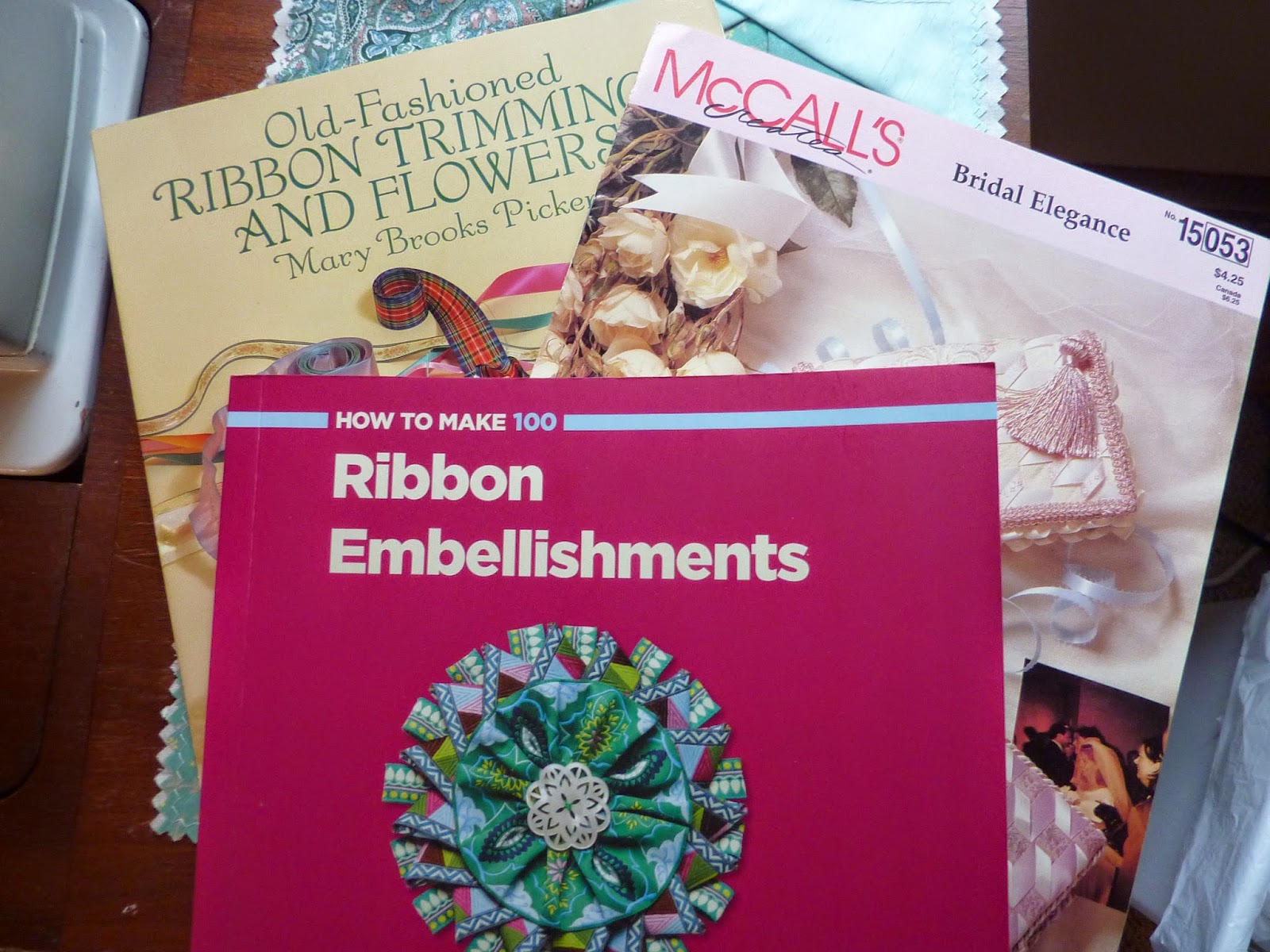
I began by replacing the center patch with a piece of woven ribbons.  For the woven ribbons I followed the directions on the booklet by McCalls called Bridal Elegance.  There are lots of possibilities with this weaving.

I believe I incorporated ten different ribbon trims/techniques not counting the little silk ribbon flowers just above the braided ribbons or the rosebud trim.  There were many more I could do but my blocks are going into a fabric book which would have flattened them so I chose to stick with the more flat techniques.  Lots of close-ups follow, captioned with the name of the ribbon trim techniques:

Ribbon Prairie Points topped with vintage rick rack, decorative embroidery and beads

Ribbon Beads Trim and silk ribbon woven through closed blanket stitch

Silk ribbon roses stitched over silk flower petals; center gathered ribbon below that
along with a ribbon bow

A little closer view of the center gathered ribbon and silk roses

Looped ribbon (top) and rosebud trim (center) - This wasn't added to block, just played with it

Another angle of looped braid and rosebud trim

Top view of two ribbon techniques

The narrow sheer ribbon in teal was used for the rushing technique -
Adds wonderful texture

Ribbon bow adorned with seed beads which also hold it in place
and a section of looped braid


3 colors of 1/4" ribbons - braided trim


Below are some books from my reference library.  I would recommend any of them.


Lots of eye candy and instructions in the following two books.  Beautiful vignettes and project photos for inspiration.


Ribbon Embellishments is a 'how to' book I just found at my local Hobby Lobby.  It is an excellent source with very clear directions and lots of photos of Trims/Braids, Rosettes and Leaves, Ribbon Sculptures and techniques with beads and baubles.  This is a definite keeper!


Now I need to figure out what I am going to do for June.  I have a few ideas but just not sure which to do next.